Thursday, October 17, 2013

The Situation of Corruption

In the evaluation article “Egotistical” written by Teylor Mock (2011), Mock suggests that the show Jersey Shore portrays the scandalous lifestyle of “Guidos” and “Guidettes” and the effect of their lifestyle on younger generations. Mock supports his thesis by addressing how the Guido’s and Guidette’s image influences society, how men judge women based on their appearance, and how these individuals create unnecessary drama. Mock’s purpose is to identify why people are wasting their time watching a show in order to prove that the values portrayed in the show are not advantageous to society. This article is directed towards everyone and Mock lures in the audience by using a pathetic appeal.
We find this article hilarious! We agree with Mock that the lifestyle of the Guidos and Guidettes is a bit egotistical. To us, their lifestyle is composed of many conceited values and their actions toward other humans are less than socially acceptable. The abbreviations GTL, FTD, and DTF are not something we want our young children learning. The way these individuals treat others represents their arrogant beliefs towards life. What really grinds our gears is the fact that these individuals stick together seeking sex for fun. How could any person be happy living a lifestyle of deceit? To us their image is nothing but a lie; making others think they are something that they are not!
Mock begins the article describing what each abbreviation means, such as FTD, or “fresh to death”. Mock then addresses how the individuals of Jersey Shore set a standard on how both men and women are supposed to look: one should have a tan, be physically fit, and dress accordingly. While these Guidos and Guidettes are at the club, if a group of Guidos sees a group of Guidettes and there is one “grenade” within the Guidette group, then the Guidos know, the group of Guidettes are not DTF, or “down to fuck” (Mock). According to Mock, these individuals are immature and “cause unnecessary drama.” Mock describes the ignorance of Jersey Shore by stating “The show also promotes the shallow judgement of women, and fornicating with people you meet at a club, solely for the purpose of having sex for pleasure rather than for strengthening a bond with someone for whom you have deep feelings.” While the younger generation may think this behavior is acceptable because it is on television, Mock renders these behaviors as “[…] deplorable things we have allowed into our mainstream culture and what we have allowed to influence us.” 

Works Cited

Mock, Teyler. “Egotistical” Connections. Southlake: Fountainhead Press, 2013. Print.

Tuesday, October 15, 2013

Judging Philosophy


          In "Education, Democracy, and the Life Worth Living" (2012), an evaluation article, Mark Kingwell claims that higher education is currently not obtained for the pursuit of knowledge, but the hopes of landing a good paying job. Kingwell establishes and supports his thesis by discussing how postgraduate degrees are sought in regards to a market advantage, personal values are endangering the standard position, the word "use" is defined by market reality, and there is a need to break the association between education and work. Kingwell's purpose is to inform people in general on the need to reevaluate what a college education is composed of in order to repair the depression created by the market advantage seeking students. The intended audiences are those individuals who define education as relating to work and Kingwell establishes a relationship with the audience by providing a background of philosophy which questions the very essence of market reality.
   Our group has found that we have different opinions on this topic. One group member claims that a personal friend obtained both a degree in Philosophy and English, yet this individual wants to be a stylist, which defines the market’s influence on what a college student pursues. Another group member agrees and blames the standard position for defining what a prosperous life encompasses. However, we all agree that the standard position defines a prosperous life as purchasing luxury cars, homes, toys, and clothes. This lifestyle is only achieved by making a good amount of money and therefore forcing envy into the minds of the general public and infusing them with the will to do whatever makes the most money, so they too can live a luxurious life. We agree that the standard position is negatively affecting students as they are the only ones left with the choice of what they do with their collegiate career.
While college students are supposed to choose what path to follow based on their career choices, market advantages, the standard position, the definition of “use”, and the link of education and work tend to affect a college student’s decision of where to direct their collegiate career- that is towards their passion or towards an abundance of money. Kingwell claims that postgraduate degrees are chosen based on market advantage by asserting that “Students respond by assuming a consumer stance to their own education, swapping tuition dollars not for the chance to interact with other minds but to acquire a postgraduate market advantage.”Kingwell further states that “When we don’t articulate the value of the humanities, we end up with the predictable spin-off into denunciations of elitism and counter-denunciations of its reverse-snobbery evil twin, anti-intellectualism.” Kingwell goes on to define the word “use” by “Things of instrumental value serve needs other their own, either some higher instrumental value or an intrinsic value. And yet, in practice, “use” almost always comes down to money, which is itself a perfect example of a lower instrumental value” (Kingwell). “The market’s monopoly on reality reinforces the dominant value of competition and selfishness, incidentally coverting education into a credential-race that can (and rationally should) be gamed rather than enjoyed” suggesting the definition of “use” is influenced by human competition and selfishness (Kingwell). Since “democracy depends on a population of engaged, critical thinkers who have general humane knowledge of history, politics, culture, economics, and science” then we, as citizens, must break the bond between education and work and once we complete that, “the value of the humanities and non-applied sciences” will become clear (Kingwell). As long as money is the driving force behind collegiate careers, there will continue to be a depression among graduating students and only a philosophical perspective can relieve the current crisis at hand.

Works Cited
Kingwell, Mark. “Education, Democracy, and the Life Worth Living” Connections. Southlake: Fountainhead Press, 2013.
          

Saturday, September 21, 2013

It Is an Investment!


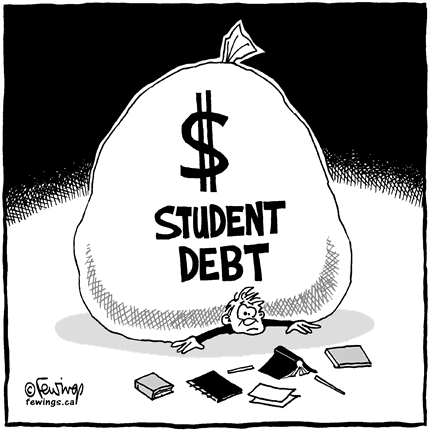
Yolanda Melville's evaluation argument, "Is College Really Worth It?" (2012) suggests that some colleges are no longer helping students obtain jobs after earning a college degree. Melville provides the audience with an example of three national law schools being sued by students, President Obama’s plan to make college more affordable, and ways to ascertain an educational investment in favor of a good job. Melville provides information of the growing student debt in order for college students to graduate knowing they will not work for a lackluster salary. College students and perspective college students are the intended audience for this evaluation argument.
 I believe Melville did a great job at identifying what aspects of college make it worthwhile. It is very important for a college student to realize what needs to be done in order to obtain a gratifying position when exiting college. It is absurd to think that one can go to college for four years and obtain a decent position within a company right after the graduation ceremony. If an individual gets their foot in the door early on - while they are still in college - the chances of them obtaining a decent position after graduation increases. Employers look for experience, initiative, and proficiency. Anything less could be considered a liability and most employers refuse to train a college graduate while paying them a comfortable salary.
 This evaluation argument is geared towards informing perspective and current college students of how to make the most of their collegiate career. Melville explains that college students have a wide variety of financial grants available to them, so instead of taking out a loan, an individual can visit with their financial aid department to search for alternatives before signing up for excessive debt (236).  Many other options are present for college students outside of financial assistance, as Melville describes, such as relinquishing negative assets and securing positive assets (236). Melville suggests that students should get involved with student organizations and start diversifying their friendships for future benefits (236). While there is no paved path to success, students do need to realize the many benefits awaiting them. With a little dedication and hard work, anyone’s dream can come true.


Works Cited

Melville, Yolanda. “Is College Really Worth It?” Connections. Southlake: Fountainhead Press, 2013. Print.

Is College Really Worth It?


k                                 In the evaluation argument "Is College Worth It?" (2010) Michelle Adam suggests that, depending on the individual circumstances of the person, higher education may or may not be worth its price. Adam presents statistical evidence based upon the Pew Research Center's surveys of adults ages 18 and older, and presidents of two and four-year, private, public, and not-for profit universities. Adam's apparent purpose is to bring attention to the increasing tuition costs when compared to the quality of education, ranking of education in America, and what factors hide behind individuals who seek higher education in order to find out if college is really worth the cost. Adam's intended audience is current college students and perspective college students. 
 Adam explained our assumptions of college through many examples. Education in the United States is not as great as some think. We ask ourselves time and time again, "Is this worth my investment?"  In today's society it is about whom you know first and what direction that points your career. We witness college graduates working minimum wage jobs at McDonald's or Family Dollar. If college students would start thinking outside of the academic box, we would be able to sustain the American dream that we long to live. We feel that Adam did a great job addressing many issues that are a major concern for Americans. 
The overall flow of "Is College Worth it?" provided interesting facts along with interesting data to support Adam’s central question - is college worth it? Although prices in the higher education system have seemed to increase, people still felt that college is a necessity (Adam 232).  Not only did the Pew Research Center study estimate, on average, that each college graduate made $20,000 more than high school graduates, but when compared to the 2010 Census Bureau data, the results aren't much different (Adam 232). Adam’s use of percentages makes the article simpler to understand and not only appeals to college students, but also to perspective college students. 


Works Cited
Adam, Michelle. “Is College Worth It?” Connections. Southlake: Fountainhead Press, 2013. Print.
1

Friday, September 6, 2013

Mirror, Mirror on the Wall...Who Has the Fairest Self-Esteem of All?

       
     Amy Gonzales and Jeffrey Hancock’s research article Mirror, Mirror on my Facebook Wall: Effects of Exposure to Facebook on Self Esteem (2011), analyzes that past studies on self-esteem and internet usage, both positive and negative, may be affected differently by social media sites such as Facebook. Gonzales and Hancock support their claim by studying objective self-awareness and the Hyper-personal Model, as well as performing a study to prove which hypothesis is correct. Gonzales and Hancock’s purpose in this study is to figure out how Facebook affects self-esteem in order to confirm which hypothesis is correct and how the internet affects one’s psychological health. The intended audience is internet users, as well as parents who allow their children to use Facebook.      

     The study proved that Facebook does not have a negative effect on self-esteem, but the study did not fully examine all of the possibilities involved with Facebook usage. First and foremost, the study was a one-time basis and did not take into consideration long-term use of Facebook. The study also failed to recognize the amount of friends each participant had, which may or may not affect the outcome of the study. As Gonzales and Hancock state “We cannot rule out the possibility that reminders of one’s social connections are partially responsible for the increase in self-esteem (201).” Although these mistakes were made, this does create a new avenue to be fully discovered and encourages further research. 

     Gonzales and Hancock start out presenting two different theories on how one’s self-esteem is affected by the use of Facebook. The earlier experiments of objective self- awareness proved that participants felt an urge to view themselves as others do, which led to decreases in self-esteem from use of pro-social behavior. Secondly, the selective self-presentation theory proved the internet gives its users the ability to carefully select what information they want public, which in return creates positive self-esteem. Since both theories oppose each other, which one is actually correct?
      
     To find the answers, a Northeastern university assembled a study. The study included sixteen males and forty-seven females and consisted of measuring self-esteem, which was measured by the Rosenburg Self-Esteem scale, and behaviors, which was measured through a series of closed ended questions. The test results on objective self-awareness were found not significant. However, the results on selective self-presentation proved significant, showing not only did selective self-presentation positively affect one’s self esteem, but significance was also found by those who edited their own profile during the study and those who viewed only their profile. Another interesting find correlates those who exited out of their Facebook profiles during the study with lower self-esteems. These findings prove that Facebook provides its users with a new avenue to question their own current psychological processes through selective self-presentation.

Saturday, August 31, 2013

Curiouser and Curiouser


          In the persuasive essay "Curiouser and Curiouser", Roger Scruton (2011) argues that technological gadgets and social media sites are changing the way we communicate and how we perceive private and public lives. Scruton supports his opinions through defining the dividing line between intimacy and exposure, outdated laws of libel and defamation, and how technology is transforming the way we communicate with one another. Scruton’s purpose is to identify social media and technological communications that are breaching our rights of privacy. The intended audience are the older generations and parents who entrust their children with such gadgets.

          We find that this persuasive essay is very well written and provides many examples to help the reader identify what problems come with a technologically savvy generation. We also found this persuasive essay a bit scary, as what you put on the internet is shared with the world. Scruton describes an incident in which journalists of the Guardian stole his emails and published them in the newspaper. At the same time, Julian Assange, was considered a hero by some when he released information that others wanted to hide. We believe that overall, the internet is a place where your personal information is not safe. Pictures can be stolen and shared by those who are trying to deface your character and these days, according to Scruton, there is little you can legally do to stop defamation. One of our group members disliked the fact that Scruton failed to provide supporting evidence, as everything Scruton stated was a personal opinion.

          Are the technological gadgets used today worth giving up certain freedoms or competencies that were once considered a necessity? Scruton suggests that “Very little is stored in our heads, and our recollections drift in cyberspace”, leaving only room to depend solely upon these gadgets to alleviate humans of mental exercises (228). Communicating is another factor that is negatively affected by the technological dependencies of this new generation. “Our personalities emerge from our interactions; all that we value and all that we fear has its source in communication”, states Scruton as he discusses the fact that humans are social creatures and communicating is indeed the basis of human life (230). Along with this complete failure in effective communicating is a privacy issue that is becoming less important to those who live within the web of the internet, as Scruton points out through the invasive measures the Guardian took to steal his emails (229). With technology sweeping the world into a technological savvy life, Scruton suggests that we are indeed losing competencies, freedoms, and the ability to communicate through technological gadgets.

Our Brain on Google

 William Badke’s article titled "How Stupid is Google Making Us?" (2012) discusses that Google is not making us stupid but rather the broadness of the technological age is transforming our brains into some sort of incomprehensible multiliterate processor that possesses the ability to research semi-effectively without using deep contemplation on the subject. Badke supports his evaluation through many discussions including: the challenges to good research, the iBrain study, different definitions for the word stupid, fears behind such a multiliterate generation, and lastly, how we can stimulate different parts of the brain to galvanize deep analysis. The purpose of Badke’s evaluation is to provide his readers with a basic understanding of how, what, and why the information age is similar and different to older generations in order to inform the current generation of how this technological age is aiding in an overall learning transformation. Badke establishes a relationship with the audience by providing interesting scientific research along with fears and suggestions as to how we can change by the way information literature is received, which enables students alike to see all sides of the argument.

Overall, we believe Badke did a great job providing a plethora of information to his readers. The iBrain study is perhaps the most interesting piece of this evaluation because it shows that just because we live in a technologically advanced world, we still possess the ability to utilize deep memory as long as we are taught how to think critically. We believe the biggest issue with information literature is not the fact that technology use has increased, but the fact that we, as students, know how easy it is to find information. Sometimes we will procrastinate on researching which leaves us with little to no time to think critically on the assignment. Sometimes our schedules are so hectic that we don’t mean to procrastinate, but it just happens. Either scenario increases the likelihood that our deep thought process is hindered simply from a lack of time set aside for the assignment, whether it is intentional or not. As stated by Badke, “Students have been doing shallow research at the last minute with minimal thought since long before the electronic age” (226) which shows us that this isn’t something that is newly found. This is a problem existent upon many students who either have too much going on or they are procrastinators.

Badke is not suggesting that Google is making us stupid, but rather stating that search engines provide information so quickly that we do not allow ourselves to think deeply. Could this phenomenon of rapid data absorption create a society capable of deep thought? Or is it absolutely necessary for students to learn and utilize deep thinking skills? Badke answers these questions quite nicely as he states, “As the more traditional educators have been saying for years, skill with information is no substitute for a shallow knowledgebase and lack of emphasis on deep thought” (226). The information is out there, but it remains up to the student to possess the ability of deep thought in order to fully understand what is being researched. Badke states nicely “that this is not an either/or situation” (226), a student must possess critical thinking skills in order to be a fully educated student. There cannot be one or the other; the two go hand in hand.